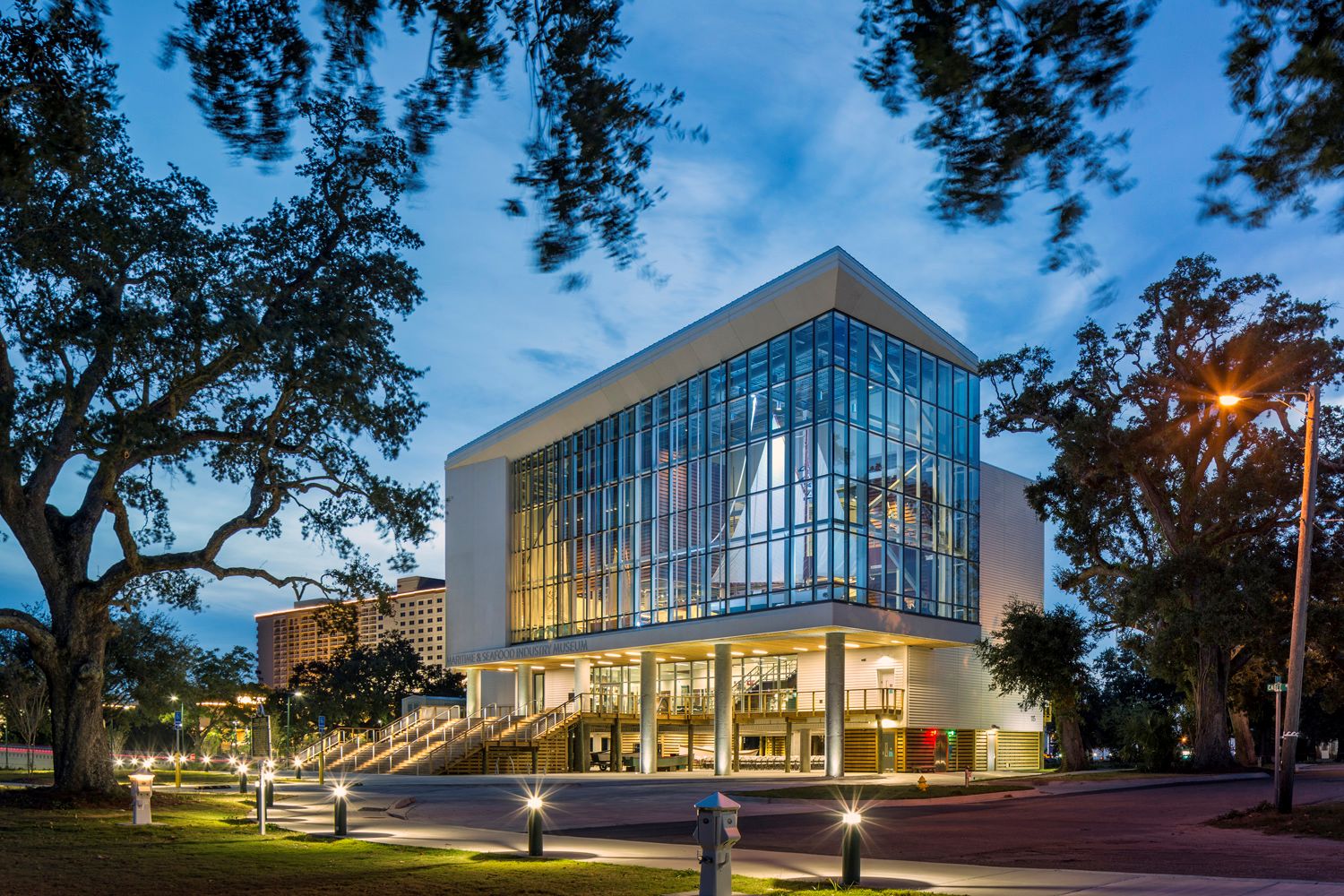
The Nydia sits behind glass like a ship in a bottle, her 30-foot mast reaching toward the ceiling of the Maritime & Seafood Industry Museum in Biloxi, Mississippi.
When Katrina’s 30-foot storm surge destroyed the original museum in August 2005, the question facing this tight-knit fishing community wasn’t whether they would rebuild — it was whether they could create something that would survive the next storm while preserving what made their community worth saving.
Three beacon projects along America’s most tested coastlines have lit the way for more than $7 billion in climate infrastructure investment. Each demonstrates a different model of what communities fight to protect: protecting first responders in Rockaway, protecting established neighborhoods in Manhattan’s Battery Park City, and protecting cultural heritage in Biloxi, Mississippi. Together, they show that the most powerful catalyst for transformative infrastructure isn’t technical innovation alone — it’s coastal resilience architecture that proves a community’s values are worth defending at scale.
Biloxi: Cultural Heritage Unlocks $5 Billion Coast Recovery
The Maritime & Seafood Industry Museum, designed by H3 principal Daria Pizzetta FAIA, became one of the catalysts for Mississippi’s $5 billion Gulf Coast recovery effort. Daria Pizzetta brought particular authority to the project: she is a Biloxi native whose grandfather shrimped these waters for sixty years.
FEMA regulations limited the new building to 19,580 square feet and required it to be elevated twenty-one feet above sea level on anchored piers — meeting FEMA Coastal A floodplain requirements — with curtain walls engineered to withstand 140-mile-per-hour winds and break-away porches engineered to float away without causing structural damage. White precast concrete panels echo the lap siding of the fishing-community architecture that once lined Point Cadet; aluminum screens recall their corrugated tin roofs.
The $5.4 million museum welcomed 30,000 visitors in its first year and helped reignite local development along the coast. By late 2007, more than $1 billion in building permits had been approved across the region, with the museum serving as proof that cultural institutions could anchor community return after disaster.
Pier A: Historic Preservation Anchors $1.7 Billion Resilience Program
Pier A in Manhattan demonstrates how adaptive reuse can serve as climate infrastructure. Built in 1886, the historic pier was abandoned for decades before Battery Park City Authority commissioned H3 to transform it into a resilient public facility. Critical systems were elevated to ten feet above ground level; harbor water heating and cooling systems were integrated into the building’s operations; flood-resistant materials were deployed at lower levels while the historic façade was preserved.
When Superstorm Sandy struck in 2012, storm surge overran the site by six and a half feet — but Pier A was operational again within months. The project now serves as a critical link in the $1.7 billion Battery Park City Resiliency Project protecting $7 billion in Lower Manhattan property value.
Rockaway: First Responder Protection Pioneers New Procurement
The Rockaway Operational Headquarters honors the Parks workers who stayed on duty during Hurricane Sandy while pioneering New York State’s adoption of design-build procurement. The shop floor is elevated to 17.5 feet — three feet above 2070 flood projections. Photovoltaic solar panels, a modular green roof system, a continuously insulated building envelope, and a rooftop generator with natural gas connection ensure the facility can operate independently after a storm event.
As one of the first projects using design-build delivery after New York adopted this method, the facility has helped unlock over $1 billion in peninsula-wide infrastructure — including a $393 million MTA Rockaway Line resiliency program, a $336 million Atlantic Shorefront Project providing six miles of dune protection, and dozens of street reconstruction projects with enhanced flood protection.
The Integrated Approach
H3 brings landscape architects, structural engineers, sustainability experts, and cultural program specialists together from the first day of a project. This integrated approach ensures that pile-supported foundations, utility strategies, and program layouts are designed as a single system serving both immediate users and the broader community — not assembled from separately optimized parts. The three beacon projects demonstrate the result: resilience and community ambition are aligned. Buildings designed for climate hazards develop more sophisticated relationships to their sites and deeper connections to the communities they serve.
Lessons for Coastal Communities
These three projects provide a replicable framework: start with what cannot be lost — heritage, neighborhoods, essential services — prove it can be protected through demonstration projects, then scale that protection to match the magnitude of the threat. The test of success isn’t whether buildings survive storms. It’s whether cities want them back afterward, and whether they light the way for the billions in infrastructure investment that comprehensive protection requires.
نبذة عن H3 Hardy Collaboration Architecture
H3 Hardy Collaboration Architecture هي استوديو متخصص في تصميم المباني المخصصة للمسرح والفنون والثقافة، وتندرج ضمن مجموعة استوديوهات التصميم Arquitectonica. منذ عام 1962، قامت الشركة بتصميم مراكز للفنون المسرحية، ومرافق فنية أكاديمية، ومسارح تاريخية، ومؤسسات ثقافية، ومباني عامة في جميع أنحاء الولايات المتحدة.
H3’s waterfront and resilience work includes the Maritime & Seafood Industry Museum in Biloxi, Pier A in Lower Manhattan, and the Rockaway Operational Headquarters. The firm has designed more than fifty performing arts centers and has been recognized with more than 100 design awards.