
When H3’s staff first walked through the New Amsterdam Theatre on 42nd Street, they found mushrooms growing in the carpet.
The building that had opened in 1903 as one of the first interiors in the United States to employ Art Nouveau decoration — described by a contemporary critic as “the most airy, fairy, beautiful thing in the way of a playhouse that the New York public has ever seen” — had been abandoned long enough for fungi to claim it. Less than a quarter of the original decorative scheme remained intact. The surviving plasterwork had been painted brown to reduce glare on a movie screen. The roof had failed. Water had worked its way into every surface.
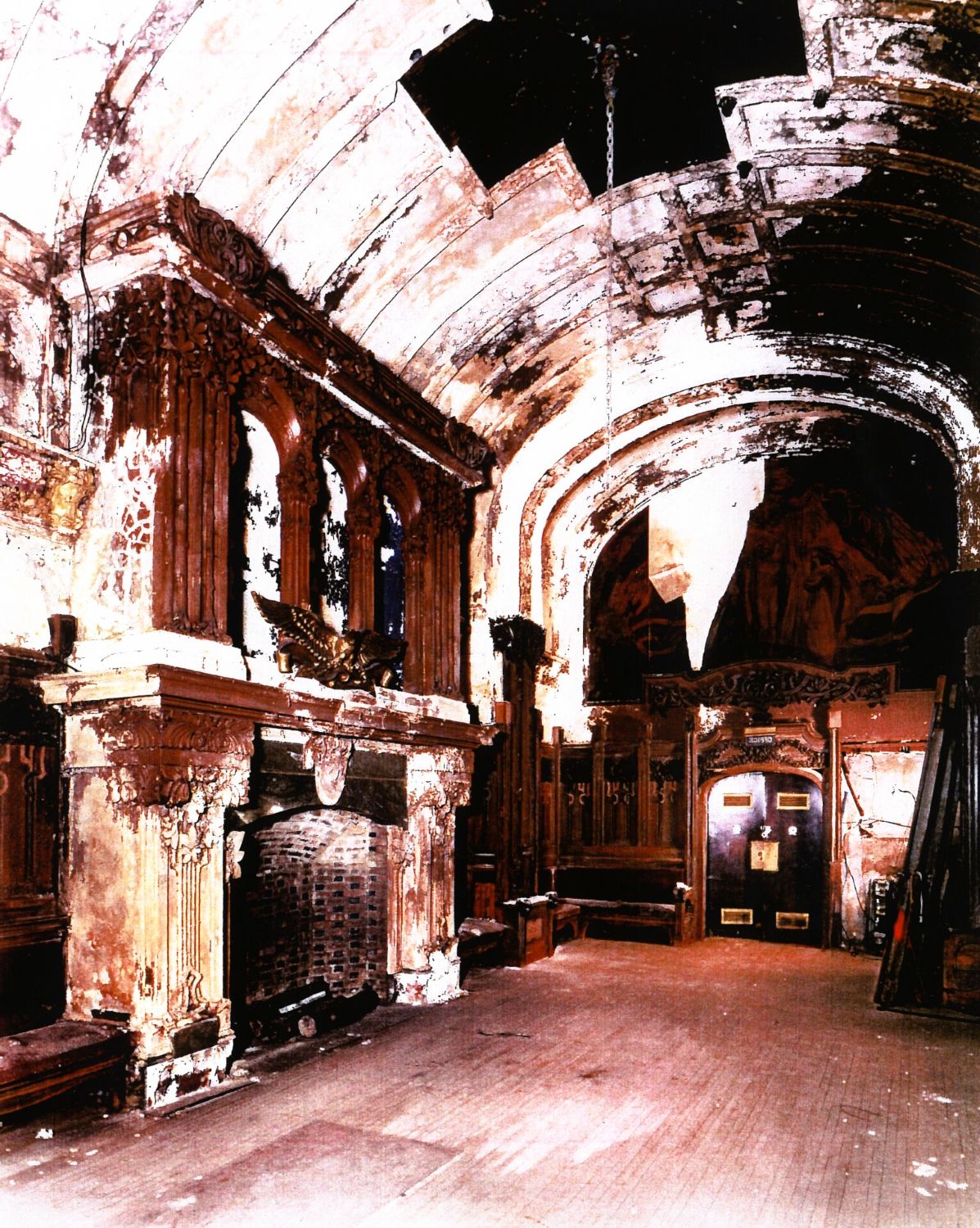
This is where historic theater restoration actually begins: not with a landmark designation or a design brief, but with the confrontation of what has genuinely happened to a building. The distance between what a theater was and what it has become is the measure of everything that follows — and how you close that distance reveals everything about what you think preservation is for.
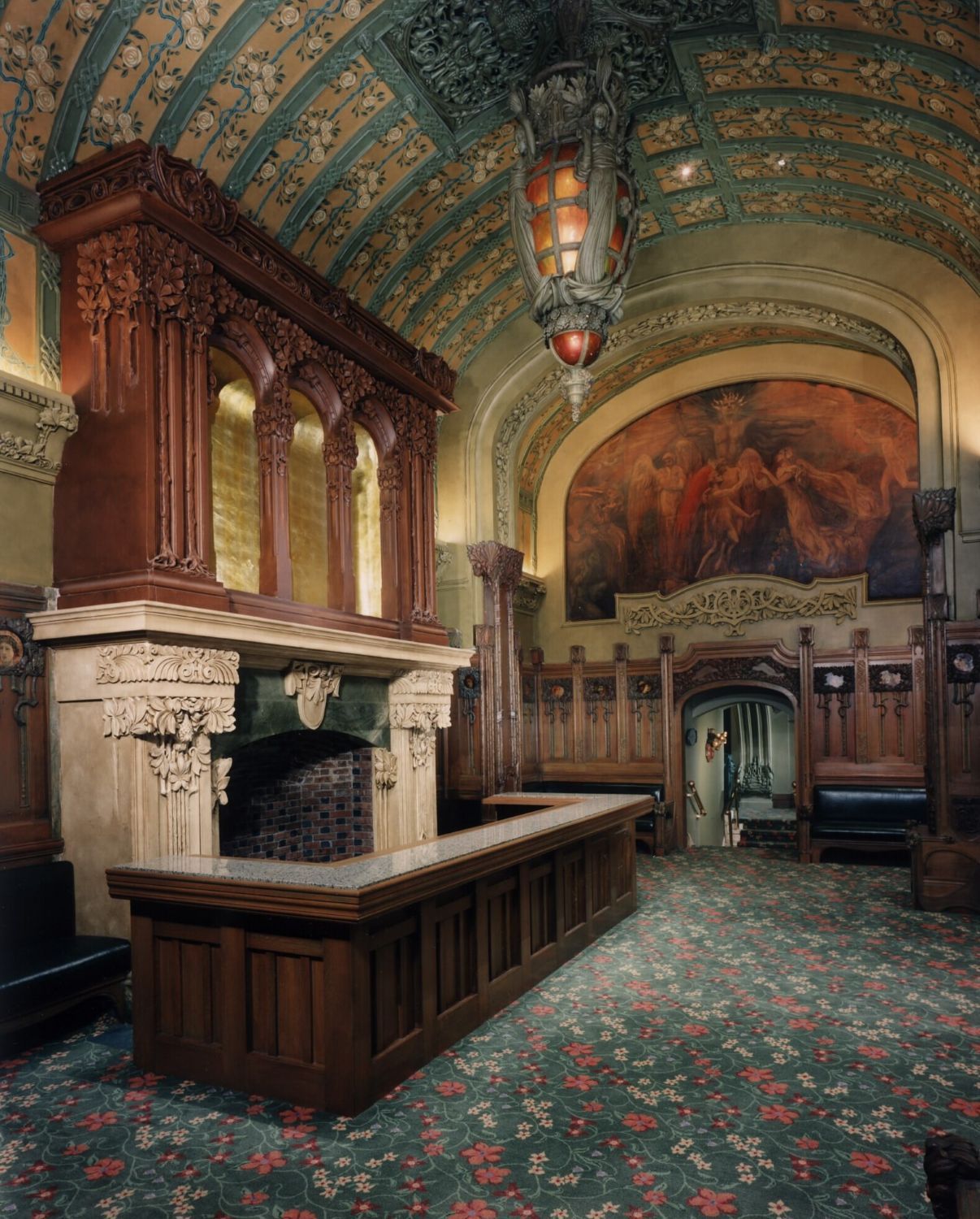
The question confronted at the New Amsterdam had no clean answer: which moment in the building’s history deserved priority? The 1903 opening? The 1913–1927 years when the Ziegfeld Follies brought Will Rogers, Fanny Brice, and Fred and Adele Astaire to that stage? The Art Deco marquee of 1937? Every period had left its mark. Every mark was partly authentic and partly an erasure of something earlier. Total restoration was both technically impossible — less than a quarter of the original fabric survived — and, more importantly, beside the point. The New Amsterdam had not been extraordinary at one moment in its history. It had been extraordinary across all of them.
Honest preservation can only interpret, never replicate.
The approach that shaped our work at the New Amsterdam, and has guided four decades of historic theater renovation since, rests on a conviction that is counterintuitive enough to be worth stating plainly: honest preservation can only interpret, never replicate. The goal is not to recover a particular moment in a building’s history but to understand what made it matter across all its moments, and to make that quality available again for the audiences and artists who will use it next. At the New Amsterdam, that meant re-creating the Art Nouveau decorative scheme from paint analysis and archival photography, inserting contemporary technical infrastructure without compromising the room’s visual character, and making new work legible as new rather than disguising it as original. The result was not a recreation of 1903. It was an interpretation that honored what the building had always been while making it ready for what it would become.
The counterargument to this approach is usually framed as a question of authenticity: if you are recreating rather than preserving, what exactly are you preserving? Radio City Music Hall is the answer, and it is not a comfortable one.
When H3’s staff undertook Radio City’s restoration, the Hall had already been through several rounds of well-intentioned work that had, in the name of maintaining the original, gradually erased it. Colors had drifted. Fabrics had been replaced with approximations. The linen wall fabric designed by Ruth Reeves — its full pattern featuring singers, musical instruments, and images symbolic of the Hall’s identity — had been severed at some point by a previous restoration, its lower half cut away and forgotten. A building designed in 1932 to celebrate what was new and modern had become, in the candid language of the project documentation, “a pale copy of its 1930s splendor.”
The restoration’s response was to remake Radio City in order to save it. Every visible finish was recreated from archival research — carpet, wall coverings, upholstery, the Ezra Winter mural that had faded from view, the Stuart Davis painting that had been gifted to the Museum of Modern Art in 1975, restored by MoMA, and loaned back to the Hall during the restoration. At the same time, the original stage machinery — hydraulic lift systems so precisely engineered that the same technology was later adapted for use on World War II aircraft carriers — was found fully operational and kept in service. All of this was accomplished in seven months between consecutive Rockette-show seasons, a schedule that left no margin for error.
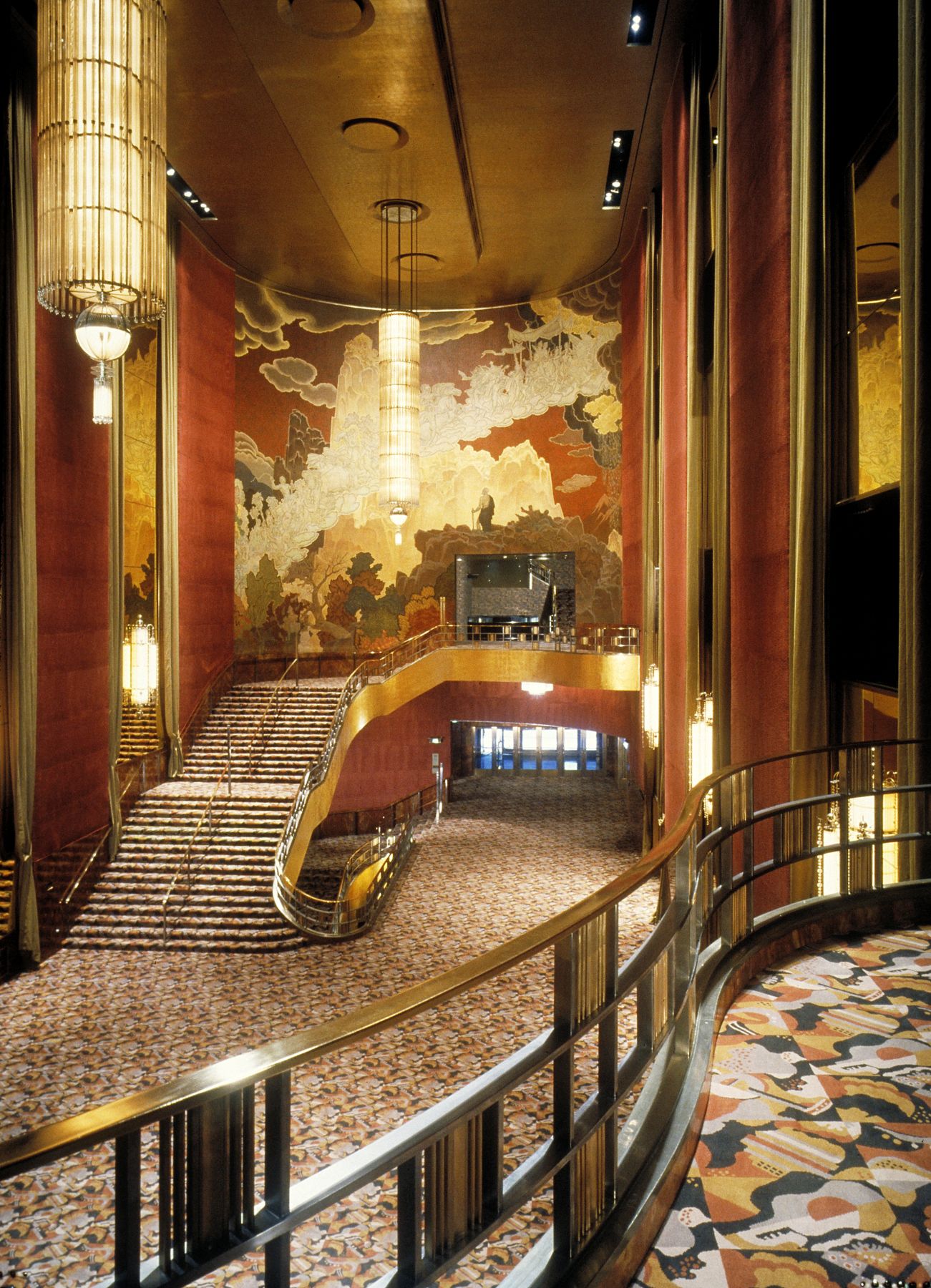
The paradox that Radio City makes visible is this: the things most likely to survive a building’s history are the things most deeply embedded in its structure, the ones no one thought to “improve.” The surfaces — the things we associate with a building’s character and identity — require constant, active stewardship to remain alive. Radio City’s stage machinery outlasted five decades of restoration efforts because no one touched it. Its carpet did not.
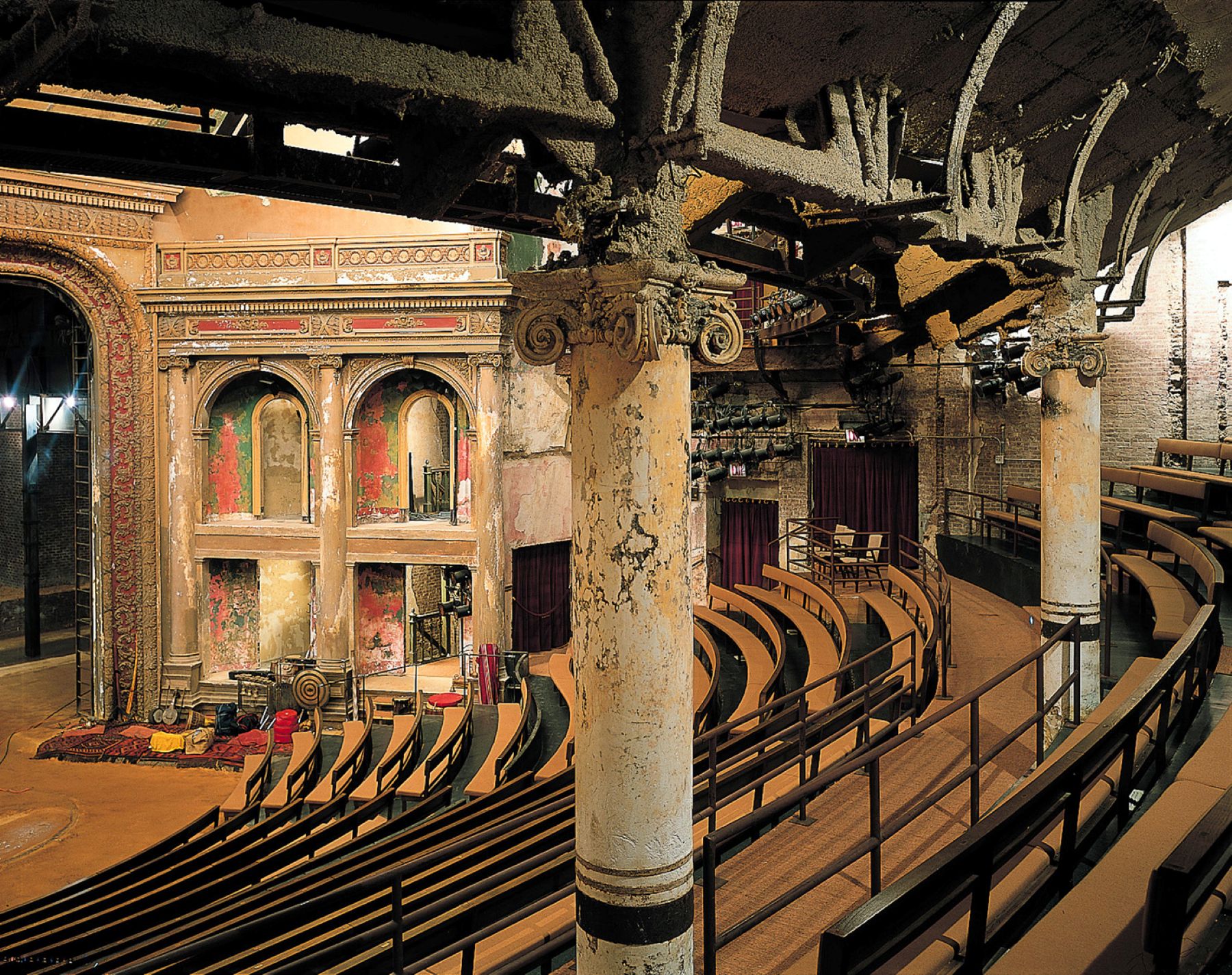
The BAM Harvey Theater states a third position, and the most polemical one. When HHPA converted the former Majestic Theatre in 1987 — the building had closed as a movie house in 1968, been taken into city receivership, and spent nearly two decades in deteriorating abandonment before BAM took it on — the central design decision was whether to restore its surfaces to a pre-deterioration condition or to preserve the evidence of what the building had been through. The decision was to preserve the evidence. Walls were stabilized and cleaned but not resurfaced. The damage was left visible. The result is a theater that feels ancient and immediate in a way that cosmetic restoration could never achieve: a room whose surfaces carry the literal record of their own survival. For nearly forty years it has been one of the most sought-after performance spaces in New York, valued precisely because it does not look like a restored theater. It looks like a place that has genuinely been through something.
Preservation is not a conservative act. It is a creative one.
Taken together, the New Amsterdam, Radio City, and the Harvey make the same argument from three different angles: preservation is not a conservative act. It is a creative one. The architect’s job is not to maintain the appearance of the past but to understand what made a building matter — and to keep that quality alive, which sometimes means recreating, sometimes means retaining, and sometimes means honestly preserving the evidence of damage and time. The skill is knowing which response a particular building, at a particular moment, requires.
What all of this requires in practice is accumulated knowledge, which means time. H3’s most significant historic theater renovation relationships have extended across decades: nearly forty years at the Brooklyn Academy of Music, from the 1987 Harvey conversion through the BAMCafé, the Peter Jay Sharp Building restoration, and the BAM Richard B. Fisher Building; more than thirty years on 42nd Street, from the New Victory through Theater Row, the New Amsterdam, and a return to the New Victory to renovate its lobby; and a long-running relationship at Lincoln Center Theater that includes H3’s 2007 renovation of the Vivian Beaumont and Mitzi Newhouse Theaters, the addition of the Claire Tow LCT3 in 2012, and ongoing discussions about potential future work. Historic theaters are never finished. They need to change and renew as their communities change around them, and the architect who knows a building’s particular history of decisions, constraints, and accumulated meaning is in a fundamentally different position from one who arrives fresh.
The mushrooms in the New Amsterdam carpet are, in retrospect, a kind of test. A building that has fallen that far could be approached as an object to be returned to a prior condition — a restoration problem with a recoverable solution. Or it could be approached as a living thing that has survived something, that contains the evidence of its own history in its walls, and that deserves an architecture honest about both what it has been and what it needs to become. The buildings that endure are the ones that received the second kind of attention.
About H3 Hardy Collaboration Architecture
H3 Hardy Collaboration Architecture is the Theater, Arts and Cultural Building Design Studio within the Arquitectonica family of design studios. Since 1962, the practice has designed performing arts centers, academic arts facilities, historic theaters, cultural institutions, and civic buildings across the United States.
H3 and its staff have maintained continuous historic theater restoration and renovation practice for more than four decades, with projects spanning Broadway landmarks, regional civic theaters, and outdoor amphitheaters — including Radio City Music Hall, the New Amsterdam Theatre, the BAM Harvey Theater, the New Victory Theater, and Lincoln Center Theater’s Vivian Beaumont and Mitzi Newhouse Theaters. The firm has designed more than fifty performing arts centers and has been recognized with more than 100 design awards.